← Back to libraryGBAMPL-2.0
The Purple Night · Play Free Online
Corwin Kuiper and Gwilym Kuiper, with music by Sam Williams
The Purple Night is a free GBA game you can play right in your browser — no download, no install, with save states, gamepad support and touch controls on mobile.
MPL-2.0 — Corwin Kuiper & Gwilym Kuiper, music by Sam Williams; built with AGB (AGB logo: CC BY-SA 4.0) · artwork source all cover credits
Play nowThe first launch downloads the emulator core — please wait a moment.
How to Play: Controls
Keyboard
| Game button | Keyboard key |
|---|
| D-Pad | ↑ ↓ ← → |
| A | Z |
| B | X |
| L | Q |
| R | E |
| Start | Enter |
| Select | V |
These are the emulator's default bindings — remap them anytime in the emulator menu's control settings.
Gamepad
Plug in any USB or Bluetooth gamepad and play right away (Gamepad API) — no setup required.
Touch / Mobile
On phones and tablets a virtual gamepad (D-pad + A/B + Start/Select) appears automatically on the touchscreen.
The emulator menu also includes save states, fullscreen and fast-forward; your saves stay in this browser.
About
The Purple Night is a Game Boy Advance platformer by Corwin Kuiper and Gwilym Kuiper, with music by Sam Williams. It is built with agb — the Rust library for GBA development — and released under the MPL-2.0 license.
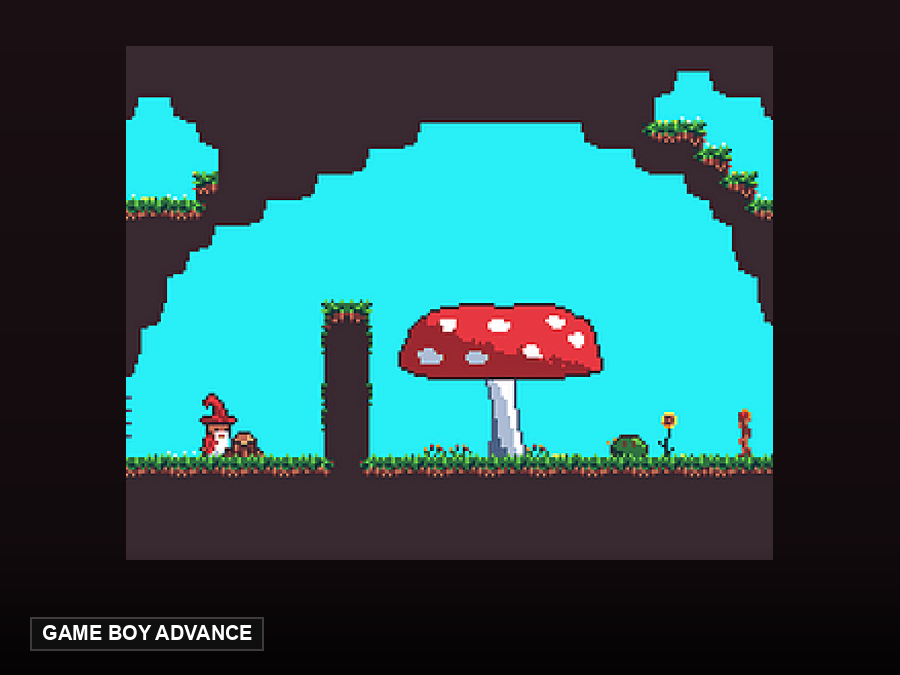
It comes from the same examples collection as The Hat Chooses the Wizard, also on this site, and like that game it doubles as a showcase for agb: crisp pixel art and chiptune audio demonstrating what a modern Rust toolchain can do with 2003-era hardware.
Play The Purple Night online free in your browser — the GBA core runs client-side, no download, with save states, gamepad support and touch controls on mobile.
Source & project page ↗
What Is The Purple Night? The GBA Platformer Where Your Sword Is Your Health Bar
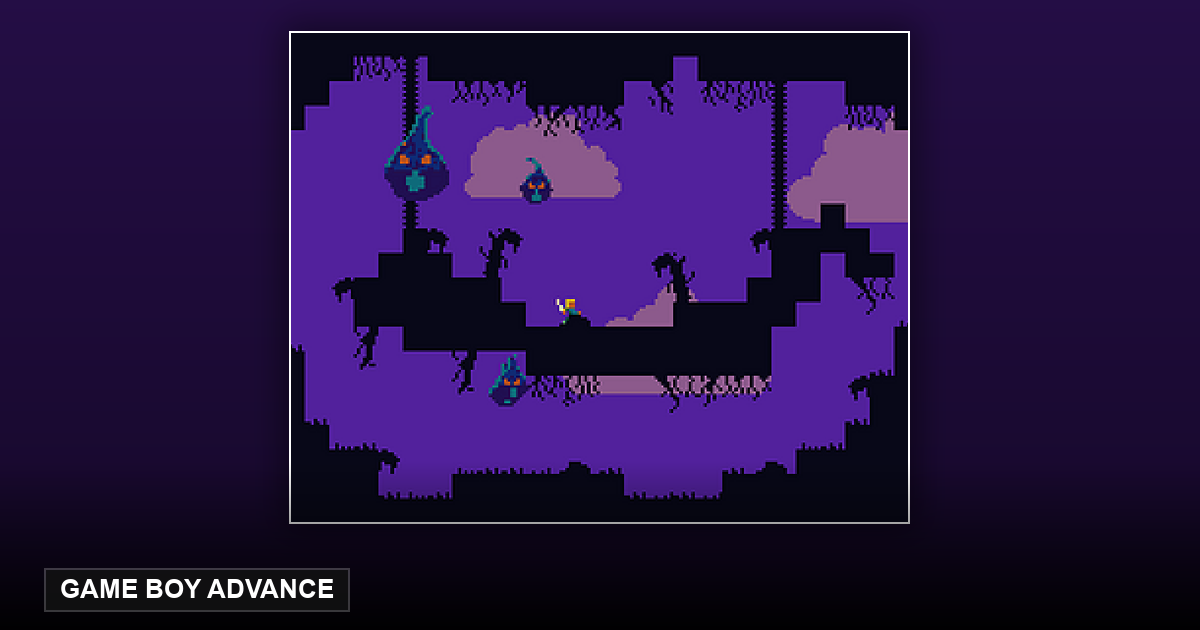
Most action games keep your health and your weapon in separate corners of the screen: hearts up top, sword in hand, and never the twain shall meet. The Purple Night welds them together. You play a swordsman whose blade is his life — every hit you take doesn't drain a bar, it physically shortens your sword. Take enough damage and your elegant long blade becomes a stubby short sword, then disappears entirely, leaving you to fight with a knife. Your health is your reach, your reach is your safety, and every mistake makes the next one easier to make. It's one of the cleanest mechanical ideas the GBA homebrew scene has produced, and you can play it here, free, in your browser.
That's the case for playing it today. This is a complete, polished platformer — distinct levels, enemies, a proper soundtrack — that happens to live inside a software library, of all places. It was written in Rust, by two of the developers of agb, the Rust framework for Game Boy Advance development, as the proof that their framework can build real games. Most frameworks demonstrate with a bouncing logo. agb demonstrates with this.
What the First Ten Minutes Are Like
It's a side-scrolling platformer first: run, jump, attack, cross screens of terrain and enemies. The sword system announces itself within the first few fights. At full health, your long sword swings in a generous arc that keeps enemies at a polite distance. Take a hit and you notice the blade is shorter — the same swing now demands you step closer to danger. Take more and you're down to a knife, playing a completely different game: precise, close-range, unforgiving.
The first ten minutes teach the economy: your sword is a resource you spend by getting hit and can only restore by finding your way back to full health. The difficulty curve is built into your own blade. A player at full health plays cautiously and keeps their options open; a damaged player is forced into risk to claw the advantage back. Where you'll get stuck is the stretch after a bad fight — the game's hardest moments are the ones where you're already wounded, because the mechanic compounds. That's the design's quiet genius: the punishment for failure is more failure, until you learn to fight clean.
The Purple Night and Its Peers
The idea of health-as-weapon isn't unknown — a few famous commercial action games have played with attack power tied to condition — but The Purple Night's take is unusually literal and legible: you can see your margin for error every time you swing. Compared to the GBA's commercial platformers, which mostly followed the genre's established rules (hearts, hits, power-ups), this feels like a deliberate design experiment, executed with the confidence of developers who ship games to prove a point. It's short enough to finish in a sitting and sharp enough to remember afterward, which is more than can be said for many games with a hundred times the budget.
Written in Rust, Shipped as an Example
The strangest and best thing about The Purple Night is its provenance. agb is a Rust framework for writing GBA games — real, modern, memory-safe Rust, compiled to the GBA's ARM7TDMI processor. Its developers, Corwin Kuiper and Gwilym Inzani, wrote The Purple Night (with music by Sam Williams) as a worked example in the framework's repository: a complete game, source code and all, that anyone can study, modify, and learn from. It's released under the MPL-2.0 license, agb's permissive, file-level copyleft — meaning the game is free to play and the code is free to learn from, with the license notice preserved. The same repository ships another complete platformer — The Hat Chooses the Wizard, a hat-throwing puzzle-platformer — making agb one of the only software libraries in the world whose documentation includes two complete games.
Playing It Here
On this site, The Purple Night runs in your browser on the mGBA core. The default keyboard mapping: D-pad on the arrow keys, A on Z, B on X, Start on Enter, Select on V, with the GBA shoulder buttons on Q and E. A USB or Bluetooth gamepad works instantly — for an action platformer, that's the recommended way to play, since the sword economy punishes sloppy inputs and a physical D-pad is the honest instrument. On a phone, the virtual buttons are serviceable, but this is precision platforming: expect the touch controls to cost you a few blade-lengths while you adjust.
Save states pair interestingly with the sword system: because your health is your weapon, a save state before a tough section is a save of your blade, not just your position. The game is short enough to finish clean, but grinding a difficult screen from a full-health state is a legitimate tactic the original hardware never offered. Saves live in your browser — closing the tab is safe, clearing browser data is not.
The Purple Night lives in our GBA library alongside Minicraft GBA for survival crafting and Apotris for pure puzzle skill — three games that each prove something different about what the platform could still do in the 2020s.
The Purple Night Tips for New Players
- Fight clean: damage shrinks your sword and your safety.
- At full health, play cautious — reach is your safety margin.
- A damaged blade forces risk — finish fights fast when hurt.
- Save-state before tough screens — it saves your blade too.
- Use a physical D-pad; precision protects your sword length.
Frequently Asked Questions
Does this game need me to bring my own ROM?
No — The Purple Night is open-source software (MPL-2.0) and loads instantly in your browser here. Our "bring your own ROM" pages are a separate feature for commercial game files.
How does the sword-as-health system work?
Every hit you take shortens your sword — long sword, then short sword, then no sword (a knife). Your health is literally your attack reach, so playing badly makes the game harder in a way you can see every swing.
Is this a tech demo or a real game?
A real, complete platformer — levels, enemies, boss-style challenges, a proper soundtrack. It ships as an example in the agb framework's repository, but it's a game first and a demo second.
What is agb?
A framework for writing Game Boy Advance games in the Rust programming language. The Purple Night and The Hat Chooses the Wizard are its showcase examples — complete games whose source you can read.
Can I play it on my phone?
Yes, with on-screen touch controls — though for a precision platformer, a gamepad or keyboard will treat your sword length more kindly.
Is it really free?
Yes — MPL-2.0 licensed, source public, playable here on this site.