← Back to libraryGBAGPL-3.0
Apotris · Play Free Online
akouzoukos
Apotris is a free GBA game you can play right in your browser — no download, no install, with save states, gamepad support and touch controls on mobile.
Play nowThe first launch downloads the emulator core — please wait a moment.
How to Play: Controls
Keyboard
| Game button | Keyboard key |
|---|
| D-Pad | ↑ ↓ ← → |
| A | Z |
| B | X |
| L | Q |
| R | E |
| Start | Enter |
| Select | V |
These are the emulator's default bindings — remap them anytime in the emulator menu's control settings.
Gamepad
Plug in any USB or Bluetooth gamepad and play right away (Gamepad API) — no setup required.
Touch / Mobile
On phones and tablets a virtual gamepad (D-pad + A/B + Start/Select) appears automatically on the touchscreen.
The emulator menu also includes save states, fullscreen and fast-forward; your saves stay in this browser.
About
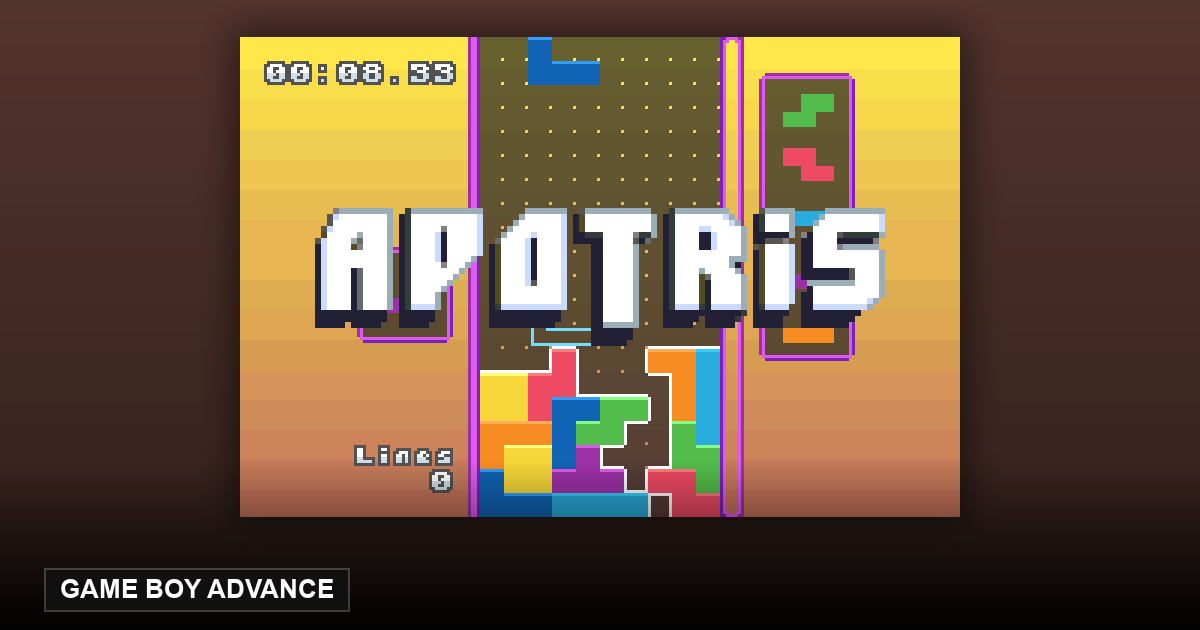
Apotris is a falling-block puzzle game for the Game Boy Advance, developed by akouzoukos and released under the GPL-3.0 license with the source code on its own Gitea forge. It is widely regarded as one of the most polished homebrew puzzle games ever made for the GBA.
The rules follow the classic stack-and-clear formula you already know, wrapped in a modern presentation: smooth controls, multiple modes and options, and quality-of-life touches you'd expect from a commercial release rather than a free cartridge.
Play Apotris online free right here — no download, no install. The GBA core runs in your browser with save states, gamepad support and mobile touch controls.
Source & project page ↗
What Is Apotris? A Falling-Block Game Built for the GBA First
Most falling-block games treat the Game Boy Advance as an afterthought: a licensed port with fixed rules, mushy handling, and nothing to adjust when the pieces refuse to move the way your hands want. Apotris is the opposite kind of project. It's an open-source stacker built for the GBA first, still actively maintained years after its first release, with control handling that modern players expect and a mode list long enough to last a winter. If you ever bounced off a game in this genre because the input "felt wrong," this is the one worth a second chance.
So let's be concrete about what's here: fourteen game modes, from a guided Training setup to a Finesse Trainer that grades how efficiently you place pieces, up to five-player battles on original hardware, and a handling menu you can tune instead of tolerate. It runs free in your browser on this site, and it's released under the GPL-3.0 license, which is part of why it keeps improving instead of sitting still.
What the First Ten Minutes Are Like
You boot into a clean mode-select screen with music that doesn't sound like a technical demo — someone composed this. Pick Marathon and the feel is different from most GBA stackers within ten seconds: no input lag to compensate for, no soft-drop that hesitates. Pieces move when you press, stop when you release, and lock when you tell them to. That sounds like table stakes; on a 16 MHz handheld, it's the whole game.
The early Marathon levels are deliberately roomy: the stack stays low, the piece queue reads at a glance, and the game quietly lets you build bad habits — the trap it springs later. Around level fifteen the gravity ramps up, and you discover whether you've been placing pieces or just surviving them.
Where You'll Get Stuck (and Why That's the Design)
The difficulty curve is mostly a skill curve, not a number curve. Marathon is the gentle on-ramp. Sprint and Dig give you a specific goal — clear lines fast, or dig through garbage rows — and your times expose exactly how sloppy your technique is. The wall arrives with Master and Death, where the pieces fall fast enough that you stop "choosing" placements and start pattern-matching them. Most players plateau here, and it's honest: the modes aren't unfair, your hands are just slower than you thought.
The real ceiling is finesse — placing each piece with the minimum number of inputs. Apotris is one of the few games anywhere that measures this for you: the Training mode's dedicated Finesse Trainer scores your placement efficiency, and it is humbling in the way a good coach is. You'll clear the same board you always cleared and find out you did it with thirty percent more inputs than needed. Fixing that is what turns a decent run into a good one.
Apotris and the Official Stackers
The GBA already has famous, competent falling-block games — the licensed ones sold millions and defined the genre for a generation. They were products of their moment: fixed handling, a handful of modes, and whatever the cartridge shipped with, forever. Apotris isn't a rebuttal so much as a continuation, by people who grew up on those games and kept going. The handling is customizable because twenty years of players learned they want it that way. The mode list is long because the community kept inventing ways to play. Where the official games froze in 2005, Apotris still ships updates.
It also stands apart from most homebrew stackers, which tend to be faithful retro recreations — loving, but backward-looking. Apotris builds forward: modern handling, a training system, versus modes against the CPU. It plays like a genre argument rather than a nostalgia piece.
The Fourteen Modes, Briefly
For reference, because the menu is deep: Marathon (the classic climb, with Cascade and Tower variants), Sprint (line-clear racing), Dig (excavate garbage rows), Ultra and Blitz (score attacks on a clock), Combo (four-wide challenge), Survival, Classic (old-school rules), Master and Death (the speed walls), Zen (no pressure, with Cascade, Tower and Zone variants), Multiplayer Battle for up to five players, CPU Battle for playing alone, and Training with the Finesse Trainer inside.
On original GBA hardware, Multiplayer Battle works over the link cable — same room, real opponents. In the browser, the versus experience comes from CPU Battle, which puts up a genuine fight.
Playing It Here
On this site, Apotris runs in your browser with the emulator's default keyboard mapping: the D-pad is the arrow keys, A is Z, B is X, the GBA shoulder buttons are Q (L) and E (R), Start is Enter, and Select is V. Plug in any USB or Bluetooth gamepad and it works instantly — for a game whose entire argument is input feel, the physical D-pad is the honest way to play. On a phone, a virtual gamepad appears on the touchscreen automatically, and Apotris's discrete inputs translate to touch better than most fast games do.
Save states matter more here than in most games: park one at the start of a Master-mode run and grind the speed wall without re-climbing the early levels. Saves stay in your browser — closing the tab loses nothing, clearing browser data loses everything.
Apotris anchors the puzzle corner of our GBA library — Minicraft GBA is the platform's survival adventure, and The Purple Night its sword-as-health platformer.
Where Apotris Came From
Apotris is developed by akouzoukos and released under the GPL-3.0 license, with the source code hosted on its own Gitea forge and a project homepage at apotris.com. The GBA is the game's home platform — the version on this site is the original — and it has since been ported to PC, Nintendo 3DS, Android, and PortMaster handhelds, with online crossplay between those ports. Free software matters for more than the price: it's why the handling keeps getting refined, why bugs get fixed in weeks instead of never, and why a game for a 2001 handheld still has a future.
Apotris Tips for New Players
- Start with Marathon to learn the feel, then use the Finesse Trainer to unlearn wasteful piece movements — good finesse is what separates smooth stacks from panic.
- Keep the stack flat and build toward one well; a clean board is worth more than one clever placement.
- In Sprint, plan your next piece while the current one falls — hesitation is the real enemy, not speed.
- Use save states before attempting risky builds (like a Tetris-ready well); retrying is instant and you learn faster.
- Try Zen mode when a mode frustrates you — it's the pressure-free way to practice stacking patterns.
- Check the in-game options: Apotris's customization (handling, visuals) is unusually deep for a GBA game.
Frequently Asked Questions
Does this game need me to bring my own ROM?
No — Apotris is open-source homebrew, and everything in this collection loads and plays instantly in your browser. Our "bring your own ROM" feature is a separate thing, for people who already own commercial game files.
Is Apotris the same as Tetris?
The core rules — stack pieces, clear lines — are the ones you know, but Apotris is not affiliated with the Tetris brand, and most of its fourteen modes exist nowhere else.
Can I play it on my phone?
Yes — the browser version works on mobile with a virtual gamepad on the touchscreen. There's also a native Android port for the full-fat experience.
Does my progress save?
In the browser, yes — the emulator's save states keep your runs until you clear them.
Is it really free?
Yes. GPL-3.0 licensed, source code public, no ads, no account, no purchase. You can play it right now on this site.
Which mode should I start with?
Marathon until the stack stops scaring you, then Sprint to find out how slow you actually are, then the Finesse Trainer to get honest with yourself. Master and Death will wait.