About
Airaki is a tile-matching puzzle game crossed with RPG battles, released for the Game Boy Color in 2014 by furrtek. It is written in 100% assembly language and open source under the GPL-3.0 license, with the full source on GitHub.
The concept is, in the author's words, simple on the outside and crazy on the inside: match tiles to charge up and unleash attacks in fast-paced battles. Airaki even had a physical cartridge run — a badge of honour for a homebrew that made it off the emulator screen and onto real hardware.
Play Airaki online free right here — no download, no install. The Game Boy Color core runs in your browser with save states, gamepad support and touch controls on mobile.
Source & project page ↗
How to play Airaki: goal and rules
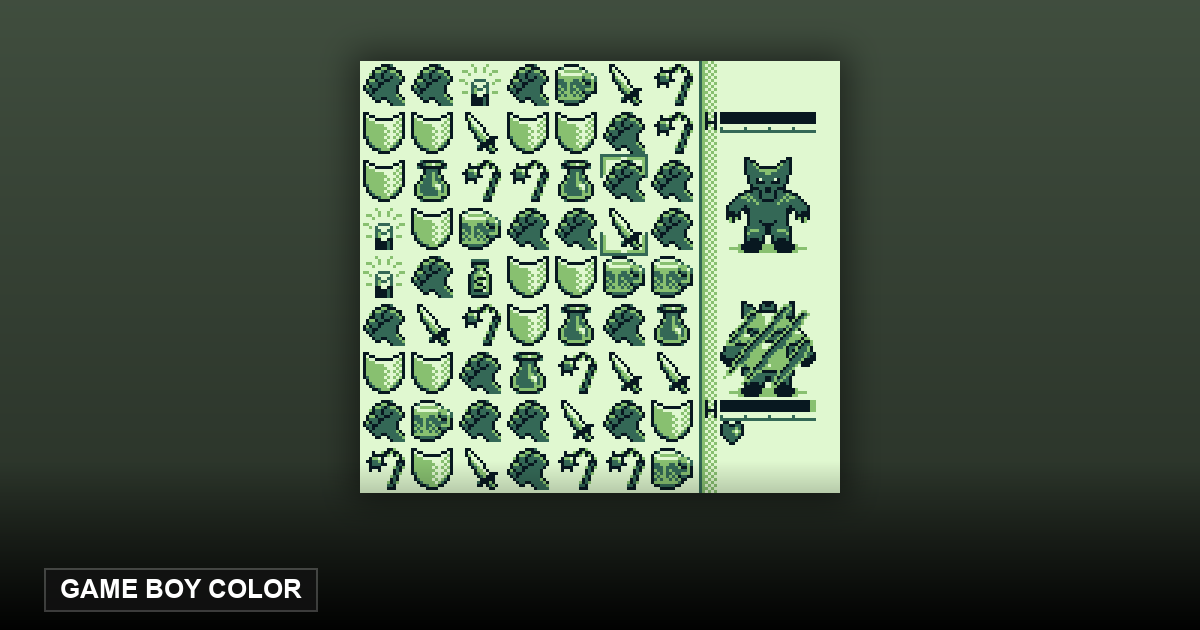
Airaki fuses tile-matching with a fighting game: a panel of icons seven columns wide, a cursor that grabs a pair of adjacent icons (horizontal or vertical), and the A button to swap them. Line up three identical icons in a row or column and they vanish. Clearing attack icons deals damage to the enemy, and longer chains hit harder — the multipliers are hard-coded in the source: ×1 for three, ×2 for four, ×3 for five. Empty the enemy’s health bar to win; a dedicated near-death animation plays when its HP runs low.
- Swapping: the cursor selects an adjacent pair, A confirms the swap; a swap that makes no match flips back on its own.
- Attack icon damage (source values): punch 3, sword 5, scourge 10, bomb 5, hammer 10 (three uses per run).
- Shields: matching shield icons grants one, cutting damage in half — upgraded tiers cut it to a quarter, then an eighth.
Your first minute
After Start, the screen comes up in classic DMG four-shade grayscale (measured: gray and black covering ninety-nine percent), Enter opens the menu, and the D-pad moves the cursor — in our test every press produced large visible changes, cursor and panel both responding. Pressing z (the A button) triggers a big swap-and-resolve change across the board. Skip the tutorial for level one: find a swap that lines up three identical icons, press z, watch the damage number fly, and the rule explains itself.
What this game is
Airaki is a match-and-fight game for the Game Boy — swap icons, chain threes, and punch enemies out one after another with the damage. One line: the author’s own words, “simple on the outside, crazy on the inside” — a versus puzzle-fighter from the 2014 French homebrew expo (FSE).
Who made it, and when
Furrtek built it in 2014 over about four months, in 100% assembly with WLA-DX, open-sourced under GPL-3.0. Sticker and instruction-sheet art by Robotwo, testing by Dyak, intro fanfare by Jankenpopp, cartridge shells by Kitsch-Bent, PCBs by PCBCart — a full physical release: the README even thanks buyers “who didn’t immediately put it on eBay for $80.”
What makes it special
Every mechanic fits in a 32 KB cartridge written in pure assembly: damage multipliers, three shield tiers, a near-death animation, panel-solvability self-checks, and two-player link-cable duels with separate master and slave source files. The attack animations include a beer bottle — the author’s humor runs from the gameplay down to the variable names. For anyone studying what Game Boy assembly can do, this GPL source is an exhibit in itself.
Who it’s for — and who it isn’t
It’s for players who like match-threes but want a fight — every chain here lands as damage on a living enemy, which makes it far tenser; and for the GB-tech curious, since the open assembly is readable and hackable. It is not for a no-stress casual session: the enemy hits back, the shield demands timing inside the attack window, and the flustered will take a beating.
Frequently Asked Questions
Is Airaki free?
Yes. It’s GPL-3.0 open source; this page runs it right in your browser, no download and no account.
Do I need to install an emulator or any software?
No. Emulation happens inside the page: no emulator, no browser extension, no plugin.
Does it work on a phone?
It runs with the built-in touch buttons. Swaps and directions are fine on touch; the shield’s timing window is a little harder on a small screen.
Why doesn’t the B button (x) respond?
B is the shield button and only works inside the enemy’s attack window — silence outside it is normal behavior, not a broken key.
What if no 3-chain is possible anymore?
Nothing to do: the game checks solvability itself and reshuffles the panel with a shake when stuck. The rescue mechanic is written into the source.